

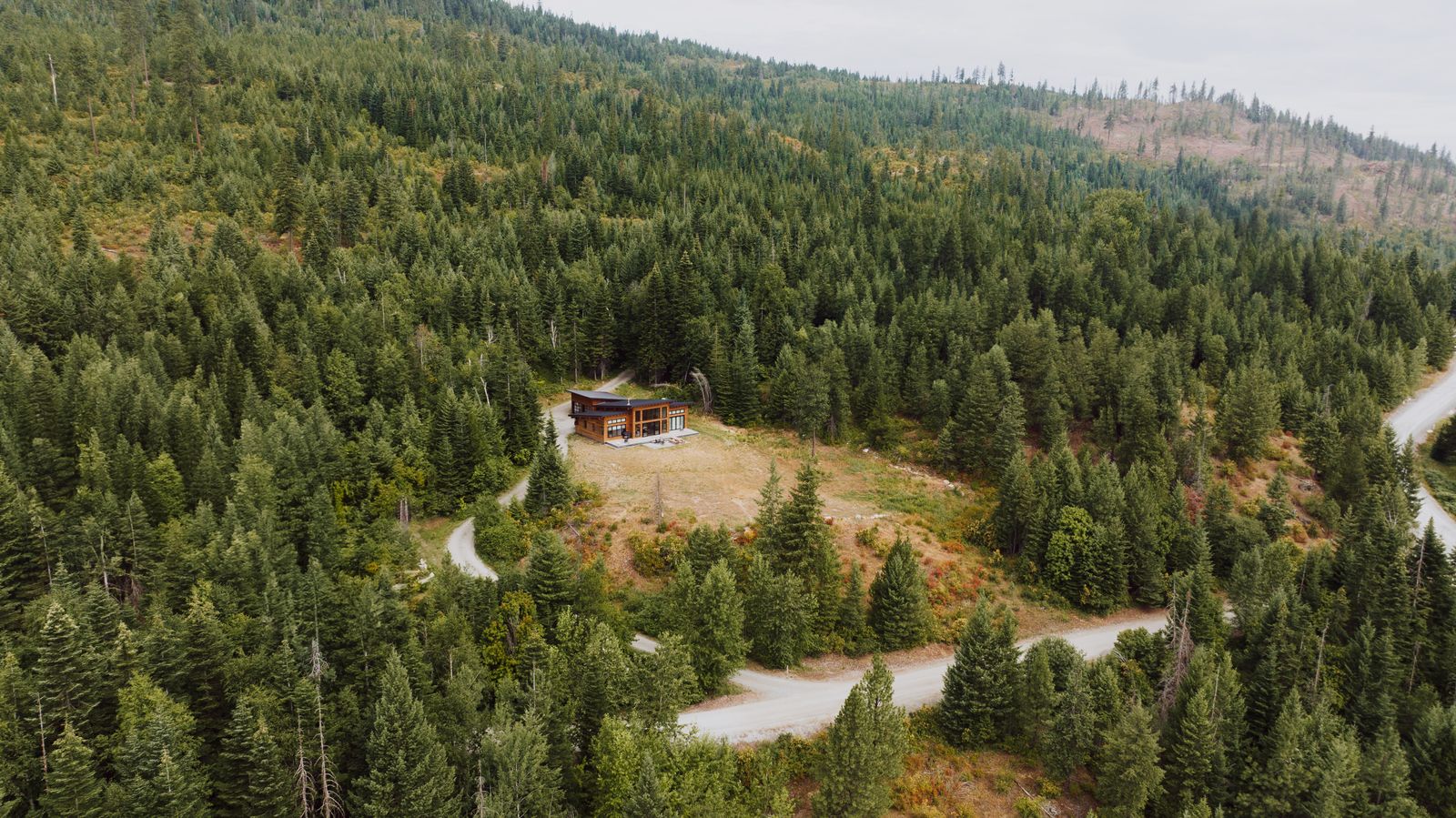
Every Methow real estate transaction is now a wildfire conversation. Buyers want to know what they are inheriting. Sellers want to know what they should fix before listing. Insurance companies are increasingly the ones deciding which deals close and which fall apart at the binder stage. After the Carlton Complex (2014), the Cedar Creek Fire (2021), and a string of smaller fire seasons in between, some of which came uncomfortably close to neighbors I know, this is something anyone with property in the valley has to think about.
The framework: defensible space zones
The state and federal “Firewise” framework breaks the area around a building into three zones. Every insurance carrier, every fire mitigation specialist, and every well-informed buyer is looking at the same zones.
Zone 1: 0 to 5 feet (the home ignition zone)
The most important zone. Embers landing in this area cause the majority of home losses in wildfire. The goal is non-combustible.
- No mulch, no woodpiles, no vegetation immediately against the foundation.
- Gravel, stone, or non-combustible pavers around the perimeter.
- Gutters cleaned of needles and leaves.
- Decks: undersides screened, surfaces clear of debris, no firewood stored beneath.
- Roof and gutter screens to prevent ember intrusion.
Zone 2: 5 to 30 feet (the intermediate zone)
- Mowed grass, irrigated where possible.
- Tree crowns separated by at least 10 feet (no continuous canopy).
- Lower branches pruned to 6 to 10 feet from the ground.
- No firewood stored within this zone during fire season.
Zone 3: 30 to 100 feet (the extended zone)
- Thinned trees with significant spacing.
- Ladder fuels (brush that lets fire climb into the canopy) removed.
- Slash piles burned or chipped, not left sitting.
Beyond 100 feet, fuel loading matters less for your specific building, but it still affects how a fire moves across your property.
What insurance companies are watching
This is the part most buyers do not realize until they are under contract. Insurance carriers, especially after 2021 and 2023, use aerial imagery, satellite data, and ZIP-code-level risk models to decide whether to bind a new policy. A property that looks fine to a buyer’s eye can be flagged as “non-insurable” by an underwriter who has never visited it.
What they look at:
- Defensible space, especially Zone 1, which is visible from satellite.
- Roof material (composite/asphalt vs. wood shake).
- Distance to the nearest fire station with structural protection.
- The property’s history (prior claims, prior near-misses).
- The neighborhood’s fuel loading and access. One-way-in roads get flagged.
What it means for buyers:
- Get an insurance quote BEFORE you waive contingencies. Do not assume coverage is available because the seller has a policy. Their carrier may be different, or their policy may be grandfathered. Get a binding quote in your own name.
- If you cannot get a quote from a standard carrier (State Farm, Liberty Mutual, USAA, etc.), the WA FAIR Plan is the insurer of last resort. Coverage and rates are limited. Build it into your cost expectations.
What it means for sellers:
- Pre-listing wildfire mitigation work is one of the best returns on investment you can make before listing. A defensible-space-clean property attracts more insurable buyers, which broadens your pool.
- Document what you have done. A folder with Firewise assessment reports, dated photos of clearance work, and receipts for tree thinning is sales gold.
What the work actually costs
Rough ranges in the Methow (verify with local contractors):
- DIY Zone 1 and Zone 2 cleanup, 1-acre lot: A weekend of your time plus $200 to $500 for tools and gravel.
- Hired Zone 2 thinning, 1 to 3 acres: $1,500 to $5,000 depending on density.
- Zone 3 thinning, 5+ acres: $3,000 to $15,000+ depending on terrain and fuel loading. Tax-deductible in some cases as a conservation expense. Talk to your CPA.
- Roof replacement (wood shake to composite): $20,000 to $45,000 depending on size. Pays back in insurability for many sellers.
- Sprinkler or exterior wetting systems: $5,000 to $20,000. Helps with some carriers, but it is not a substitute for clearance.
The work that costs the least and helps the most is Zone 1. The 5 feet immediately around your house. A weekend of cleaning gutters, removing mulch against the foundation, and clearing under the deck is the most insurance-positive thing you can do.
Resources every owner should know
- Okanogan Conservation District offers free Firewise assessments for residential properties in Okanogan County.
- Methow Valley Long Term Recovery is a local nonprofit supporting fire-affected residents; a good resource for community-level updates.
- Methow Ready is the community emergency preparedness program, with checklists and event calendars.
- WA DNR Fire Risk Maps are public data on fire risk by parcel. Useful for buyers evaluating a target property and for sellers understanding your risk classification.
- Firewise USA is the national framework, with Methow-specific neighborhood programs that can reduce some carriers’ rates for participating residences.
The conversation you should be having
If you are buying: walk the property with this checklist in hand. Ask the seller what they have done in the last 12, 24, and 36 months. Ask for documentation. Get an insurance quote in your name before contingencies expire. If the answer to “what fire mitigation has been done?” is “nothing, but it’s been fine,” that is a red flag, not an endorsement.
If you are selling: spend a fall weekend on Zone 1. Get a Firewise assessment scheduled. Document what you do. Bring it into the listing packet. Properties that come with clean defensible space and documentation move faster than those that don’t. The difference is meaningful once buyers can compare a documented property to an undocumented one side by side.
If you are already an owner: the work that helps you sell is the work that protects your house when fire comes. Doing it on a calm year is much easier than doing it during evacuation prep.
Wildfire is not a Methow Valley-specific problem, but the Methow has had more direct lessons than most. The owners who treat fire prep as ongoing maintenance, not a one-time project, are the ones whose properties hold value, hold insurance, and hold their place in the valley for the long run.
If you want help thinking through fire prep for your specific property, or want to know how it factors into a sale or purchase, reach out. I work with most of the mitigation contractors in the valley and can point you to the right people.